

Remember
With the plugin, each agent session opens with the decisions in force, by name and id.


npm i -g @mnema/codeRemember
Enforce
Prove
mnema verifypublic: local integrity verified (T1/T2/T4); 1 tail(s); all events are signature-covered; 1 backup key(s), which sign nothing until restored (informational, not a break; --verbose names the key); external witness (T3): not covered, nothing outside this machine attests this record
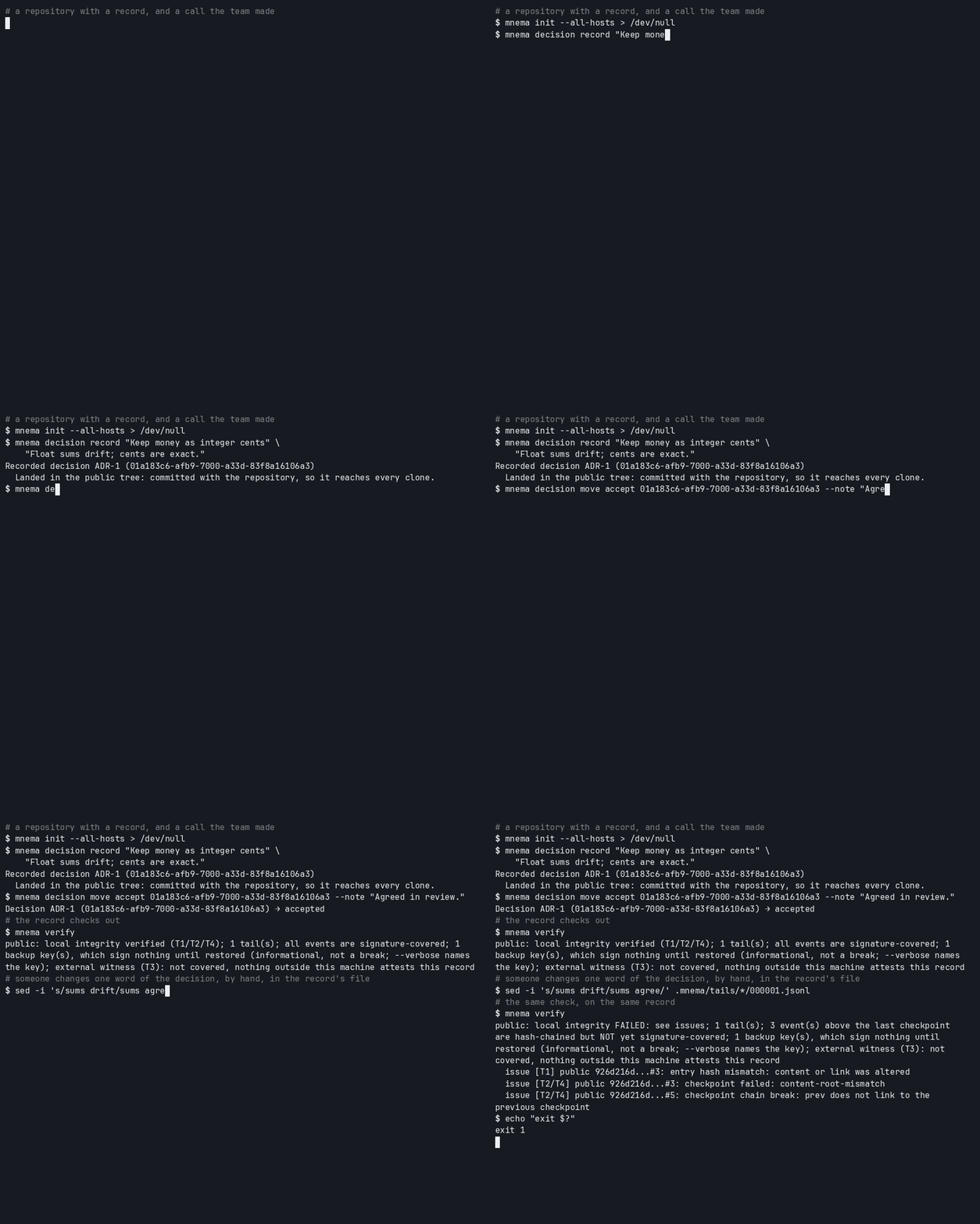
mnema verify names the event whose hash no longer matches and exits 1. A cut that takes the newest events together with their checkpoint is not caught: a hash chain shows what changed, never what is gone (what it proves). Recorded from the built binary by recordings/a-tamper-caught.sh.Record
Rule
agent-accepts is on (the default; an agent's acceptance is marked as its own), and mnema link addresses it at a path. The rule can govern that path, ask for a person there, or refuse a write.Hand over
Verify
mnema verify, a second reader in Python, or the page mnema site writes checks it.Your agents settle choices all day: a library, an approach, an option turned down. Those choices usually live in a chat that ends, in one tool’s memory or in somebody’s head, where nobody can check who decided them or whether they were changed since. mnema writes them down in the repository, next to the code, with their reasons and what was turned down. The record is signed and only grows: a change of mind is a new entry that supersedes the old one, never an edit. Where the host runs hooks, each session opens with the decisions in force, and anyone can check offline that what it holds was not changed since it was signed. What is measured, and what is not, is on the evidence page.
npm i -g @mnema/code # the binarycd your-repositorymnema init # founds the record in .mnema/mnema decision record "Keep money as integer cents" "Float sums drift; cents are exact."mnema decision move accept ADR-1 --note "Agreed in review." # a decision enters proposed; accepting puts it in forcemnema link ADR-1 src/billing --rel refuses-a-write # the rule, addressed at a pathmnema verify # reads the signed record; one line saying it is intact is the greenNo agent has run yet: that is the record, a rule in force, and the proof. ADR-1 names the first
decision of a new record. To hand the record to an agent, install the plugin for your host; in
Claude Code:
claude plugin marketplace add felipesauer/mnemaclaude plugin install mnema@mnemaEvery other host is in Hosts. mnema init also writes the mnema
instructions into AGENTS.md and the other files agent hosts read, naming each; at a
terminal it first asks which of them, and mnema instructions --remove takes them out. The first record, step by step, is
Your first record.
Each of these is a choice with a reason, and the reasons are in Where it fits.
mnema verify reads the events and the committed public keys of a project’s trees (no private
key, no network) and prints each verdict verbatim, naming the level it reached.
verify --require=signed fails when they were taken out.verify crosses a project’s trees for a retirement, and a reader of one tree does not. A refusal of a write covers a host’s editing tools, not its shell: sed -i on a protected file goes round it.verify means. That nothing verifiable is broken, not that the record is honest, and the gate protects the shape of a change, not who may make it.The whole table, claim by claim, is in docs/what-it-proves.md; how each
claim about the agent hosts is held, and which are not held yet, is in docs/evidence.md.
mnema 0.1.4 · commit cebc4e8da68c